Home & Living
Decorative Pillows That Work: Shape, Fill, and Placement
A pillow can soften a room, sharpen its color story, and make a chair more inviting. The best ones do not merely look arranged: they earn their place by fitting the furniture, the room, and the way people actually live.
Published November 28, 2026
Decorative pillows occupy a curious position in the home. They are small enough to seem like finishing touches, yet prominent enough to change the character of a bed or sofa. A room may feel unfinished without them, then crowded the moment too many arrive. Their success depends on a simple balance: appearance, proportion, and use.
That balance begins with a question too often postponed until after shopping: What should this pillow do? It might add height behind sleeping pillows, lend a backrest to someone reading, introduce a contrasting texture, or give a compact chair a more comfortable seat. Different jobs call for different shapes, fills, and placements. Once function is clear, decorative choices become easier—and less likely to end in a pile of cushions moved from one end of the sofa to the other.
Begin with the furniture, not the trend
A pillow arrangement should make sense in relation to the surface it occupies. A generous bed can carry larger shapes and several layers; a narrow bench or petite armchair cannot. The dimensions of the furniture, the height of its back, and the amount of usable seating matter more than a fashionable count of pillows.
On a bed, square Euro pillows are often used as a substantial back layer. Their scale gives the arrangement height and helps connect the bed to a headboard or wall. Standard sleeping pillows can sit in front, followed by one or two smaller decorative pieces if the bed has enough depth. The result need not resemble a showroom. It should leave room for sleep without requiring a nightly pillow-removal operation.
A sofa asks for a different calculation. Its pillows should support the way people sit, rather than consume the space where they would sit. A large square cushion can anchor one end, while a smaller rectangular accent may fit neatly against an arm. If a sofa is shallow, bulky pillows can make it feel even shallower. If it is deep, a supportive pillow behind the lower back may turn a handsome seat into a more comfortable one.
Chairs are less forgiving. Their backs and seats set firm limits, so a single well-proportioned cushion may be more useful than a matched pair. A lumbar shape can provide support without rising awkwardly above the chair. A compact square can add softness, but it should not force the sitter forward or spill over the arms.
Shape is a design decision—and a practical one
Square pillows are versatile because they work across beds, sofas, and occasional chairs. A large square creates a broad field of color or pattern; a smaller one can sit in front of it without competing for attention. Their regular geometry also makes them useful for establishing a tidy foundation before introducing a less formal shape.
Rectangular and lumbar pillows bring a different rhythm. Their horizontal line can break up a row of squares and provide targeted support behind the waist or lower back. On a bed, a single rectangle near the front can make a layered arrangement feel considered. On a sofa, it can fit between larger cushions or sit at the center as a modest focal point.
Round, bolster, and other unusual forms can add contrast, but novelty is not a substitute for fit. A cylindrical bolster may work along the edge of a daybed or against the arm of a deep sofa. A round cushion can interrupt an arrangement of squares in a pleasing way. In either case, its silhouette should relate to the furniture rather than appear as an unrelated object that wandered in from another room.
Scale is the quiet rule behind all of this. Large pillows beside one another can look calm if the furniture is generous and their tones are related. On a small sofa, the same arrangement may feel like a wall. A useful test is to step back and check whether the pillows frame the seat or obscure it. If the eye sees cushions before it sees the furniture, the arrangement may need editing.
Fill changes the feel of the room
The cover is what a visitor notices first. The fill is what the person sitting down notices next. Together, they determine whether a pillow holds a crisp outline, settles into a relaxed shape, or provides meaningful support. Pillow fill is not just a matter of softness; it affects loft, resilience, weight, and how much attention the pillow needs over time.
Down is valued for its light, yielding feel and its ability to be shaped by hand. A down pillow can be gently compressed and fluffed back into form, making it well suited to layered decorative arrangements. It tends to look relaxed rather than rigid. Some people prefer that softness; others may want a firmer, more consistent cushion, especially for everyday back support.
Down-and-fiber blends aim to combine loft with a more supported or stable feel. Euro Decorative Pillows, for example, are described as having a cambric cotton shell and a fill made from 50 percent premium white goose down and 50 percent natural milkweed fiber, with 600-fill power. That kind of blend can offer a pliable surface while helping the pillow maintain visible height. The right choice still depends on personal preference, and product descriptions should be read alongside care instructions and any relevant material sensitivities.
Synthetic fills can be a practical option for households looking for straightforward maintenance or a feel that is less dependent on frequent fluffing. Their performance varies by construction and quality, so the label alone does not tell the whole story. Pay attention to whether a cushion springs back after use, whether the fill shifts into corners, and whether the manufacturer provides clear cleaning guidance.
For a pillow intended to support someone while reading or relaxing, structure matters. A cushion that collapses immediately may look plush but provide little help. A very firm insert can hold its shape but feel stiff against the body. Think about the expected contact: a pillow used mostly for decoration can prioritize loft and silhouette; one used daily behind the back should be judged with comfort in mind.
The cover supplies color, texture, and upkeep
Fabric gives a pillow its visible personality and much of its tactile character. Cotton can feel familiar and adaptable, while sateen offers a smoother surface with a subtle sheen. Linen brings a more relaxed texture; velvet can add depth and a richer play of light. Each material changes how color reads. A muted shade on a smooth, lustrous fabric may feel more formal than the same shade on a textured weave.
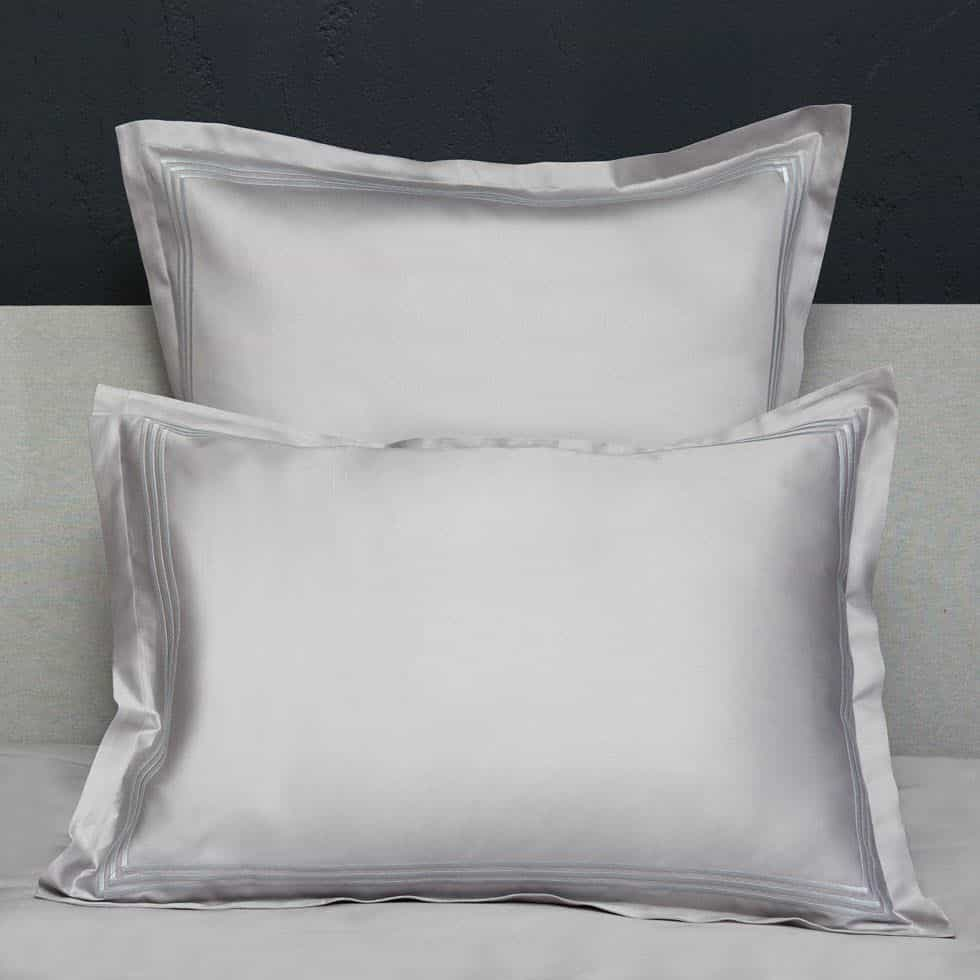
Construction details deserve a closer look. Seams, closures, and edge finishes influence both appearance and durability. A flange—a narrow border extending beyond the main seam—can give a sham a tailored outline. Embroidery can add a small, precise accent without requiring a bold print. The Platinum Sateen Sham, for instance, is made from 100 percent extra long-staple cotton sateen with a 300-thread count and features three embroidered lines and a one-inch flange. Those details make it a clear example of how finish and construction can contribute to a polished bedding layer.
Care is part of design, too. A pale, delicate cover may be beautiful but less suited to a busy family room than a washable, hard-wearing fabric. Check whether the cover can be removed, how it should be cleaned, and whether the insert needs separate care. If a pillow will be used every day, choose materials whose maintenance fits the household’s habits. A beautiful object that cannot tolerate its intended life is not a particularly useful one.
Placement: build a composition, then leave space
A balanced arrangement often starts with the largest pillows at the back and the smaller ones toward the front. On a bed, Euro pillows can establish height against the headboard, with sleeping pillows layered in front. On a sofa, larger squares may sit near the arms, while a smaller rectangle or accent pillow provides a change of scale closer to the center. This is a flexible starting point, not a rulebook.
Symmetry can give a bed a composed, orderly appearance: matching shapes at each side, perhaps with a smaller accent in the middle. Asymmetry often feels more relaxed in living rooms. A pair at one end of a sofa and a single cushion at the other can work if their color, texture, or visual weight has enough in common. Balance does not require identical objects; it requires that no one side seem accidentally heavier than the other.
Color can help connect pillows to the rest of a room. Begin with an existing element—a rug, a curtain, a painted wall, or the upholstery—and draw one or two tones from it. A pillow does not need to match exactly. In fact, a close but not identical shade may give a scheme more depth. Repeating a color in different materials, such as a matte cotton beside a smoother sateen, creates continuity without making the room feel too coordinated.
Pattern works best when its scale varies. A large, energetic motif can be balanced by a quieter stripe or a solid. Several patterns can coexist when they share a palette and do not all compete at the same intensity. Texture can do some of the work usually assigned to print: a nubby weave beside a smooth cover provides contrast without introducing another set of colors.
Most important, protect the room’s negative space—the clear area that lets furniture and objects breathe. A sofa needs open seating. A bed needs to be usable. A chair should remain easy to enter and leave. If a pillow must be moved every time someone sits down, it may be serving the photograph more than the room.
A useful arrangement changes with the season
Pillows are among the simplest ways to shift a room’s mood without replacing furniture. In warmer months, lighter colors and breathable-looking textures can make a space feel fresh. In cooler months, deeper tones, denser weaves, or a more tactile cover can introduce warmth. These changes need not be dramatic. A single accent pillow can adjust the palette; changing every cushion at once may be unnecessary.
Seasonal rotation also offers a chance to inspect the pieces already in use. Fluff inserts, check seams, and clean covers according to their care labels. Rotate cushions so that one side does not take all the wear. Store unused covers in a clean, dry place, and avoid compressing delicate fills for long periods if doing so could affect their loft.
A short checklist before choosing
- Use: Decide whether the pillow is mainly decorative, intended for lounging, or expected to provide regular support.
- Proportion: Compare its dimensions with the bed, sofa, or chair, and preserve enough room for comfortable use.
- Shape: Choose squares for flexible layering, rectangles for a horizontal accent or targeted support, and unusual forms only when they suit the furniture.
- Fill: Consider loft, firmness, resilience, material preferences, and the care required to keep the insert looking its best.
- Cover: Check fabric feel, color, construction, closure, and cleaning instructions—not appearance alone.
- Placement: Arrange from larger pieces to smaller ones, then remove anything that obstructs the seat or makes the composition feel crowded.
The best pillow is the one that stays in use
Decorative pillows succeed when they make a room more welcoming without turning comfort into a chore. Shape establishes proportion. Fill determines whether the pillow feels soft, supportive, or somewhere between. Placement gives the arrangement its order, while fabric and finish carry color and texture into the room.
There is no universal number of pillows, nor one correct arrangement for every home. A spare bedroom may benefit from a generous row of Euro pillows; a family sofa may work better with two cushions that can be moved easily; a reading chair may need just one supportive accent. Let the furniture set the scale, let the materials suit the household, and let actual use have the final word. When the room looks considered and people can settle in without rearranging it first, the pillows are doing their job.